Enclosed garden for a safe cat life
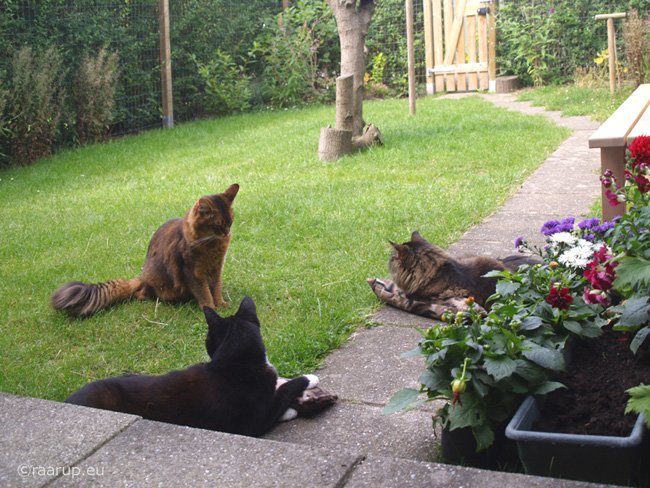 We don't want our cats to be become numbers in the
sad statistics of almost 200 cats killed by
trafic each and every day in the small country of Denmark.
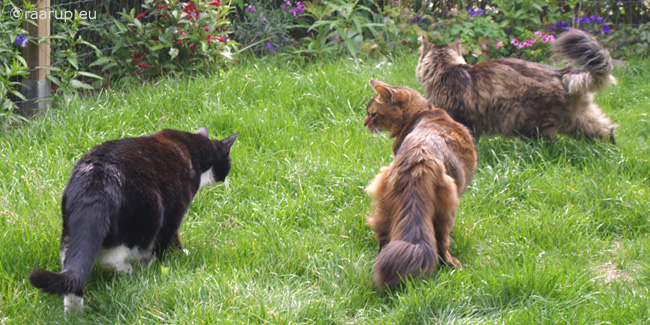
Consequently we have enclosed the garden so they won't roam
the vicinity. Although we live in a quiet neighbourhood the
risk of trafic accidents, loose dogs, catfights, diseases etc. is
greater than we are willing to accept.
We don't want our cats to be become numbers in the
sad statistics of almost 200 cats killed by
trafic each and every day in the small country of Denmark.
Consequently we have enclosed the garden so they won't roam
the vicinity. Although we live in a quiet neighbourhood the
risk of trafic accidents, loose dogs, catfights, diseases etc. is
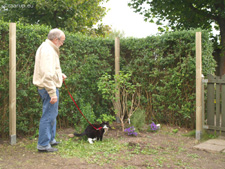
greater than we are willing to accept.Besides that we may have chosen to live with cats, but our neighbours haven't. Keeping the cats on our own property is the easiest way to avoid complaints about fouled sandboxes and scratched cars. When we moved in we built a cat run on the verandah for a start, but the following year we decided to enclose the entire garden, which is a mere 70 m² in all. We kept the old cat run in place over winter, until we were sure the new enclosure would be enough to keep the cats in.
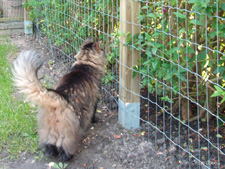
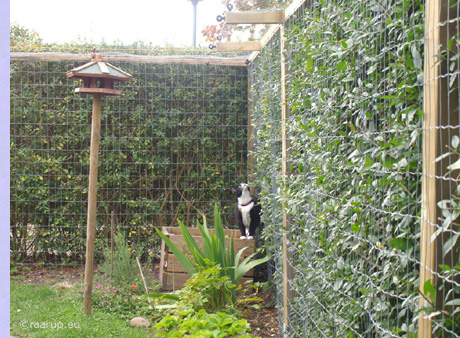 The enclosure is designed to be escape proof - for athletic cats
as well as the ingenious ones.
The enclosure is designed to be escape proof - for athletic cats
as well as the ingenious ones.We have used a wire mesh 180 cm wide, which is the maximum fencing allowed around here.
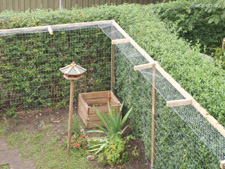
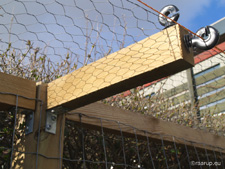
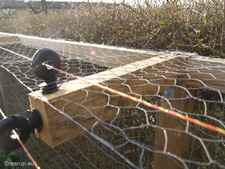
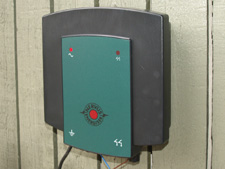
Size of the holes are 10x5 cm, which is sufficient to stop most grown cats getting through. On top is a 30 cm shelf from chicken wire, as most cats don't like climbing upside down. On the shelf are 2 electrical wires fed from a power energizer designed for small pets. An extra precaution in case one of them should climb up anyway...
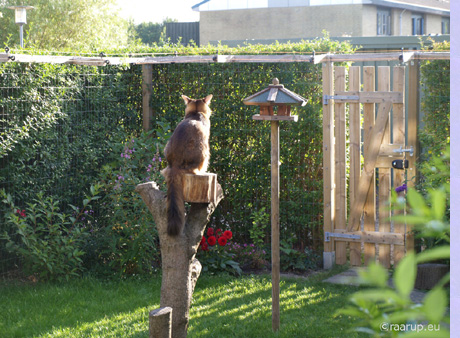 It might work without the shelf, but it also serves the purpose
of spacing the electrical wires from the hedge.
It might work without the shelf, but it also serves the purpose
of spacing the electrical wires from the hedge.We have no trees to jump over from and the old tree stump and the birdfeeder have been moved to the centre. A different solution would have been to cover the garden entirely with chicken wire, but we like having birds visiting, when the cats are in.
Also covering with a 180 cm max-height would make the garden feel claustrophobic, as well as gathering snowdrifts on top in the winter.
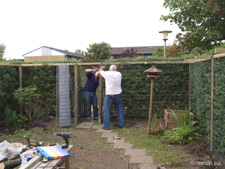
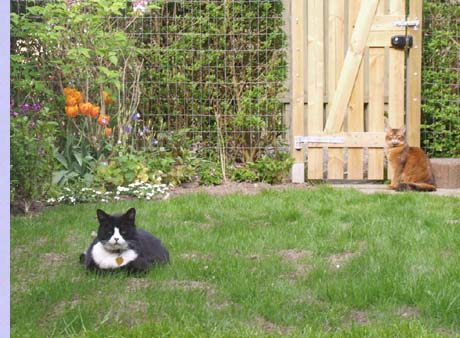 The 180 cm poles are placed
in pole anchors hammered 75 cm into the ground. Usually a pole
should have a third of it's length buried underground, but as
the fence is placed inside a hedge, less will do.
The 180 cm poles are placed
in pole anchors hammered 75 cm into the ground. Usually a pole
should have a third of it's length buried underground, but as
the fence is placed inside a hedge, less will do.At any rate I'm happy I chose anchors instead of digging holes for the poles, as there were plenty of stones and rubble just below the topsoil. I have built the garden gate from directions in an article at Handyman.dk. I've added a cylinder lock, so that no outsiders can open the gate by mistake.